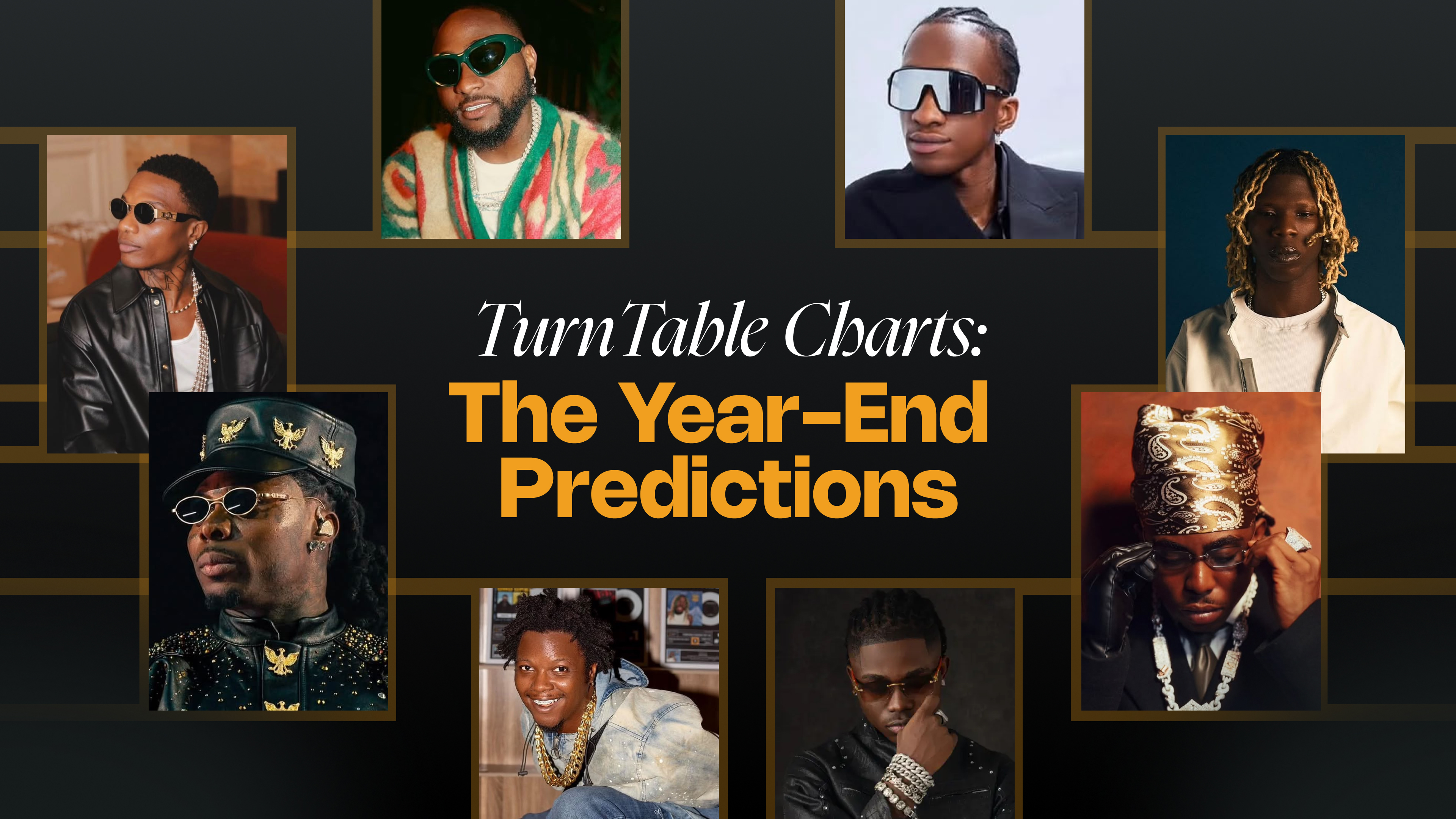
TurnTable Charts- The Year-End Predictions
From the race for Song of the Year to the artistes, albums and producers shaping the sound of the moment, we examine the contenders who could emerge at the top of TurnTable Charts Year-End Rankings. Every year, the Nigerian music industry produces records that dominate conversations, projects that define an era and artistes whose influence extends beyond the music itself. But when the conversations settle and the numbers are counted, only a few can claim the distinction of finishing at the top.
As the year approaches its final stretch, attention turns to the performances that will define its musical legacy. Which song will emerge as the year's biggest record? Who has done enough to claim the title of No. 1 Artiste? And which albums, producers and genre-defining records will stand above the competition?
TurnTable Charts' No. 1 Predictions examines 11 categories, identifying three contenders in each and assessing who could ultimately finish on top. From Afropop and Street-Pop to Gospel, Hip-Hop and Traditional music, the selections reflect the breadth of a Nigerian music industry that continues to evolve in sound, audience and commercial ambition.
These are the races to watch.
1. No. 1 Song:
Contenders: “Jogodo” by Wizkid and Asake, “MONEY CONSTANT” by DJ Maphorisa, DJ Tunez, Wizkid & Mavo, “Forgiveness” & “Gratitude” by Asake
The race for the year's biggest song is arguably the most consequential of the entire predictions series. Beyond virality and public recognition, the eventual winner must demonstrate the kind of sustained consumption that separates a momentary hit from a defining record. “Jogodo” enters the conversation with the combined star power of Wizkid and Asake, two artistes whose respective audiences give the collaboration considerable commercial potential. A record of this scale has the ingredients to compete for mainstream attention, but its ultimate standing depends on how consistently it converts that attention into chart performance. “MONEY CONSTANT” joins the shortlist, and outright contender that shook the industry from December 2025 till date. Meanwhile, Asake's “Forgiveness” and “Gratitude” strengthen his presence in the category, presenting two records with the potential to compete for sustained audience attention.
2. No. 1 Artiste:
Contenders:Asake, Wizkid, Seyi Vibez, FOLA, Davido and Mavo.
The race for No. 1 Artiste is a contest of overall performance rather than the popularity of a single record. An artiste’s position should reflect the combined strength of their eligible releases, chart longevity and ability to sustain audience attention throughout the tracking period. Asake's case rests on the breadth of his catalogue and his ability to remain a major presence in Nigerian popular music. Wizkid brings an established international audience and the potential for high-performing releases, while Seyi Vibez represents a formidable force within the contemporary Nigerian soundscape. FOLA's inclusion reflects his growing commercial relevance and the performance of his releases, while Davido enters the conversation with an established catalogue, considerable audience reach and sustained influence. Mavo completes the expanded shortlist, representing the growing impact of emerging names within the Nigerian music landscape.
3. No. 1 Album:
Contenders: ‘M$NEY’ by Asake, ‘FUJI MOTO’ by Seyi Vibez and ‘catharsis’ by FOLA
While a hit single can generate immediate attention, a successful album must sustain interest across its tracklist and continue attracting listeners beyond its release window. ‘M$NEY’, ‘FUJI MOTO’ and ‘catharsis’ enter this conversation as three projects competing for recognition in a category where longevity may prove just as important as opening-week performance. The strongest contender will be the project that translates its release-day momentum into sustained consumption. Tracklist depth, the performance of individual songs, continued streaming activity and the album's overall chart trajectory should all inform the final assessment.
4. No. 1 Producer:
Contenders: Magicsticks, BlaiseBeatz and SB
Producers are central to the records that define a musical year, yet their contributions are often discussed less frequently than those of the artistes performing the songs. The No. 1 Producer category offers an opportunity to assess that contribution through measurable impact. The question is not simply who produced the most songs, but whose production credits translated into the strongest chart outcomes. Magicsticks has built a recognisable association with contemporary Nigerian hitmaking, while Blaise Beatz and SB remain contenders whose cases should be assessed through their eligible credits and the performance of the records they helped create. The decisive factor would be the collective performance of each producer's qualifying catalogue, with appropriate attention to the chart methodology and credit eligibility.
5. No. 1 Afro-Pop Song:
Contenders: “Jogodo” by Wizkid & Asake, “Gratitude” by Asake and “Waist” by Omah Lay
Afro-Pop continues to provide a central space for the sounds, melodies and production choices that shape mainstream Nigerian music. Its biggest record must do more than generate a conversation; it must sustain consumption and demonstrate staying power. “Jogodo” benefits from the attention surrounding a collaboration between two established artistes. “Gratitude” and “Waist” complete a category in which sustained chart performance should take precedence over assumptions about which record has the greatest potential.
6. No. 1 Street-Pop Song:
Contenders: “Forgiveness” by Asake, “MCBH” by Asake and “Remember” by Asake
Street-Pop remains an important part of Nigeria's contemporary musical identity, connecting local expression, distinctive delivery and audience participation with the wider commercial music ecosystem. The category presents three contenders whose final positions should be determined by the reach and durability of their records. “Forgiveness” enters the discussion alongside “MCBH” and “Remember,” creating a race in which the numbers should settle any debate about which record has performed best over the tracking period.
7. No. 1 Gospel Song
Contenders: “Aanu Ni”by BisiManuel, “Ko’rin Iyin” by EmmaOMG” and “Oluwatosin” by Tkeyz & SteveHills
Gospel music occupies an important place in Nigeria's listening culture, with records finding audiences through streaming platforms, congregational settings and personal listening. Determining the category's leading song requires the same commitment to evidence applied to mainstream music, while accounting for the relevant gospel-chart methodology.
“Aanu Ni,” “Ko’rin Iyin” and “Oluwatosin” make up this shortlist. Their eventual ranking should reflect their eligible chart performance and the extent to which their audiences have sustained engagement over time.
8. No. 1 Hip-Hop Song:
Contenders: “Raindance” by Dave & Tems, “CHANEL” by Blaqbonez & Asake and “What You Saying” by Lil Uzi Vert
Hip-hop's chart performance increasingly reflects a complex relationship between streaming consumption, mainstream crossover and the ability of a record to maintain attention beyond its initial release. The category's three contenders present a race that would be settled by their qualifying chart performance.
“Raindance,” “CHANEL” and “What You Saying” are assessed against the same criteria: chart peaks, accumulated points, longevity and eligibility for the category.
9. No. 1 International Song:
Contenders: “Money Constant” by DJ Maphorisa, DJ Tunez, Wizkid & Mavo, “Nakupenda” by TxC, Davido, Shoday & Scotts Maphuma ft Zlatan & AI Xapo and “Raindance” by Dave & Tems.
The international category introduces a different dimension to the predictions: the performance of eligible records beyond the boundaries of a single domestic genre. “Money Constant,” “Nakupenda” and “Raindance” form the shortlist. Their final positions will depend on their performance within the applicable chart framework.
10. No. 1 Traditional Song:
Contenders: “FUJI MOTO” by Seyi Vibez, “Many People” by Adekunle Gold and “Lonely at the Top” by Asake.
Traditional music and its contemporary interpretations remain significant to Nigeria's musical identity. Records that draw from established sounds can reach wider audiences while retaining elements of the musical traditions from which they emerge. “FUJI MOTO,” “Many People” and “Lonely At The Top” make up this race.
11. No. 1 Emerging Artiste:
Contenders: NO11, SSSoundgawd, Priesst, Kweku Smoke, Obedo PF, Boy Muller, ScottyOlorin, TxC, Kidd Carder and Abefe
Emerging artiste recognition is about more than identifying a new name. It is an opportunity to recognise acts demonstrating growing relevance, increasing audience engagement and the potential to sustain their momentum. This year's shortlist brings together eleven names representing different stages and dimensions of emerging musical relevance. From the growing recognition surrounding SSSoundgawd, NO11, Abefe and Priesst to the expanding profiles of Scotty Olorin, Kidd Carder, Kweku Smoke, Obedo PF and Boy Muller, the category reflects the diversity of talent competing for a stronger position within the music industry making this a particularly competitive category.
The Year-end predictions are exercises in weighing evidence against uncertainty. An early chart leader can lose ground, a record with modest initial momentum can accumulate points over time, and an artiste's overall performance can prove more consequential than the success of a single release. The 11 categories considered here offer a framework for examining those possibilities. However, these selections remain provisional editorial predictions. They should not be mistaken for confirmed chart rankings or presented as statistically established outcomes without the supporting data. For TurnTable Charts, the value of this series lies in making the reasoning behind each prediction transparent. By combining chart evidence, consistent eligibility rules and category-specific analysis, the series can give readers a clearer understanding of not only who might finish at No. 1, but why.