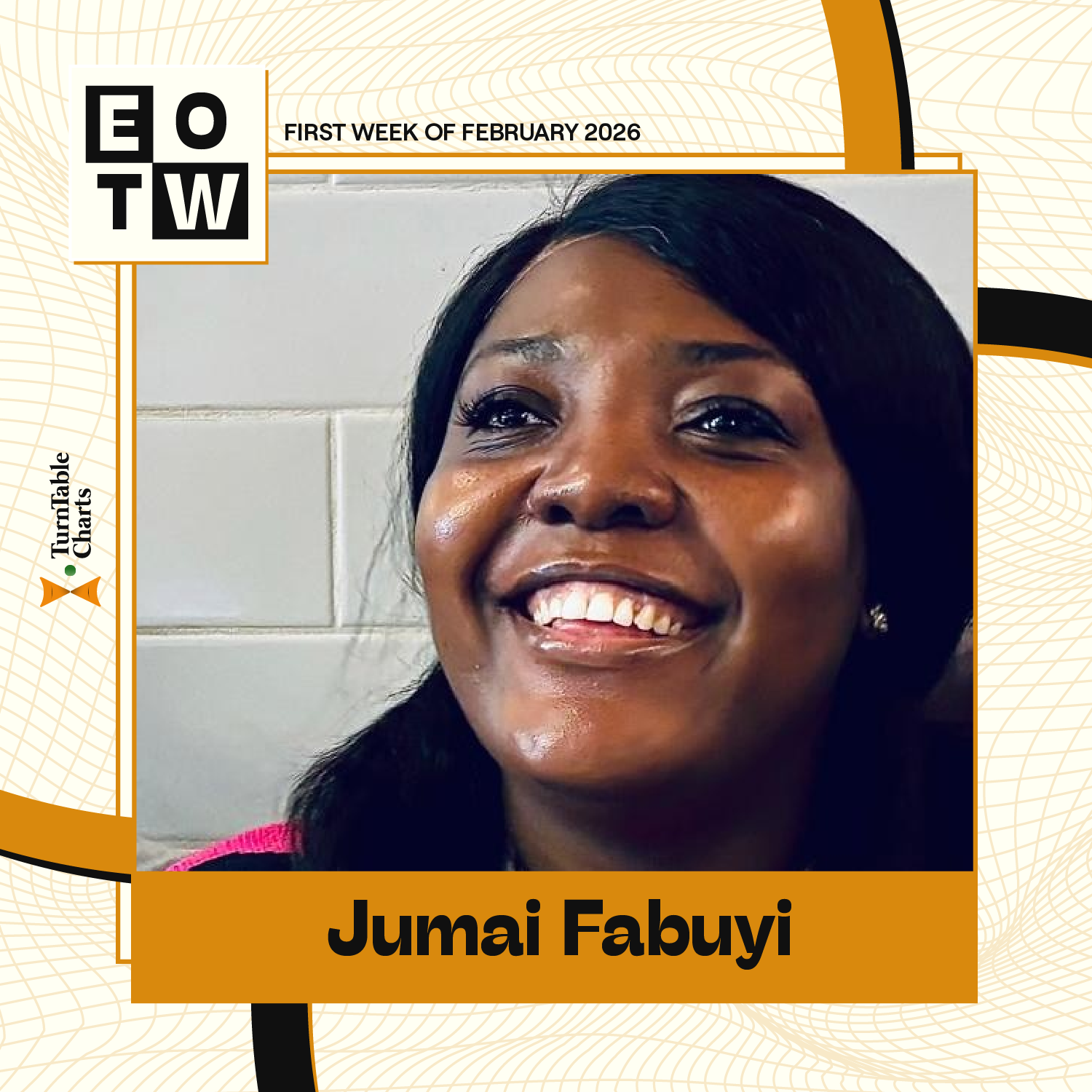
Executive of the Week — Jumai Fabuyi
Seyi Vibez has built one of the most commanding catalogues that continues to demand attention with every release. From his debut project, ‘NSNV‘ to the most recent album, ‘FUJI MOTO’, Seyi Vibez has been nothing short of distinctive.
By the close of the 2025 charting calendar, Seyi Vibez was announced as the artiste with the biggest tally by any artiste in a single year. Seyi Vibez achieved this with 724.4 million on-demand streams across all platforms in Nigeria in 2025. He becomes the first artiste to surpass the 700-million mark in a single year, with a steady rise from 65.6 million streams in 2021, 76.8 million in 2022, 532.97 million in 2023, and 642.2 million in 2024.
Seyi Vibez has carried that dominance to 2026 with a new Omah Lay-featured track, “MY HEALER”, reaching a new peak of No. 4 on the Official Nigeria Top 100 in just its second week on the chart, marking its first full tracking week. Now at a total of 5.3 million on-demand streams, “MY HEALER” has 61 million total radio impressions.
Behind these numbers is a tightly run operation. These outstanding numbers have earned Jumai Fabuyi, a lawyer and manager to Seyi Vibez’s manager the Executive of the Week title. In an extensive conversation with TurnTable, Jumai Fabuyi discusses her role within the music business, the creative direction behind ‘FUJI MOTO’ and its collaborations, navigating past controversies, and building longevity in a fast-moving industry. She also discusses artiste management, the relationship between ‘Children of Africa’ and ‘FUJI MOTO’, and what lies ahead for Seyi Vibez, including touring and fashion ventures.
TTC: Hello, and thank you for joining us. Could you start by introducing yourself and telling us a bit about what you do?
Jumai: I’m Jumai Fabuyi. I'm a lawyer. I work on the business side of music. I help shape strategy, handle partnerships, plan releases, and think long-term about where an artiste is going, not just what’s dropping next. Most days, I’m protecting the art and making sure the business side doesn’t mess up the magic. On real days, it’s a lot of problem-solving, late nights, and staying calm when things get loud. And a fun fact, when I’m not doing music stuff, my actual day job is AI governance and data privacy, so either way, I spend my life managing chaos and risk.
TTC: Seyi Vibez’s MY HEALER, featuring Omah Lay debuted on the Official Nigeria Top 100 chart. How did this collaboration come together?
Jumai: It honestly happened very naturally. Seyi and Omah Lay speak the same emotional language when it comes to music. They’re both very open and honest with their feelings, and that really shows in their songs. When the record first came up, it was actually called 22, and Omah Lay got it immediately. There was no long explanation needed. Once they linked up in the studio in Canada, everything just flowed. They were locked in, bouncing ideas off each other, and letting the song become what it needed to be. Nothing felt forced or overthought. And there’s actually another surprise artist on the record as well, which makes the song even more special. It was really just the right people, in the right space, at the right time, making magic.
TTC: Is there a creative connection between the new “MY HEALER” release and the ‘FUJI MOTO’ album?
Jumai: Yes, very much. MY HEALER lives in the same emotional space as FUJI MOTO. The album is really about healing, survival, faith, and growth, and that song fits right into that story. There is a song for everybody on the album. It feels like a small window into the bigger world of the project, just more personal and stripped back. And honestly, we made a lot of music during that period. A lot of songs didn’t make the album, so we were also thinking about how to still let some of those records live and find the right moments to drop them. You can’t fit everything on one album, unfortunately.
TTC: For the 2025 charting calendar, Seyi Vibez emerged as the most-streamed artiste for the second consecutive year, this time with 724 million streams. What does this milestone mean for you and your team, and how does this influence the next phase?
Jumai: It was a really big moment for us, and not just because of the numbers. For me, it actually sealed what I’ve been saying for a long time about Seyi Vibez’s supremacy. People connect deeply with his music, even the ones who act like they don’t. A lot of people listen in secret, and now the numbers are exposing everyone. Turns out everybody is NSNV.
For the team, it was reassurance that patience really works. It showed us that we don’t have to rush or panic. It also raised the bar for what comes next. We’re thinking more about legacy, global reach, and making sure every release means something. When you hit that level of success, you get the freedom to move with more intention.
TTC: The achievement came in a year Seyi Vibez released fewer songs than usual. From a management point of view, how were you able to maintain his popularity and even further grow it?
Jumai: It’s important to say that this was a very intense year for us at NSNV. A lot was happening behind the scenes. High emotions, pressure, drama, everything. We really just needed to trust ourselves and the audience. We focused on timing, storytelling, and making sure the records we put out actually landed. We didn’t feel the need to flood the market or drop music every five minutes. We let the songs breathe and gave people time to live with them. Even with all that, the music still carried itself. And let’s be honest, people stream Seyi Vibez quietly. They might not always post him, but they’re listening. The numbers don’t lie.
TTC: Seyi Vibez recently released his fourth album, ‘FUJI MOTO’. Can you walk us through the creative process behind the title and the general making of the project?
Jumai: FUJI MOTO really came from a very clear place for Seyi. He was in his happy zone and knew exactly what he wanted to say and how he wanted to say it. The idea of movement, power, and roots just made sense to him, something fast, grounded, and very Nigerian. A lot of the music came from late nights, real conversations, and things he was actually living through at the time.
I also try not to interfere with his creativity. He makes the magic first. He sends the songs and then the team sits with them and picks the ones that feel the most special to us. After that, Seyi still makes the final call. So it’s very organic. Nothing was rushed. The project was really lived in.
TTC: Still on the ‘FUJI MOTO’ album, there were some internationally featured artistes. How did the collaborations materialize?
Jumai: For the collaborations, it was never about chasing big names or forcing international looks. It was really about energy and alignment. Something interesting about all the features was that these were people who understood Seyi’s sound and respected where his story comes from and just reached out to him. Most of those collaborations started from real conversations, not emails flying around. There was mutual respect on all sides, and once that connection was there, the music came together very easily. And like I said, there is a song for everybody on the album. When it feels right, you don’t have to overthink it.
TTC: Earlier in 2025, the ****‘Children of Africa’ EP was released and later included in the ‘FUJI MOTO’ album. What was the reason behind that move?
Jumai: With Children of Africa, it always felt like the foundation of FUJI MOTO. The themes matched, the message matched, and the way listeners connected to it made it clear that people already saw it as part of a bigger story. So including it in the album just felt natural. We wanted everything to feel like one continuous journey, not scattered projects with no link between them.
TTC: Following the controversy involving Seyi Vibez and his distribution company, how did the brand regroup and evolve into its current phase?
Jumai: Former distributor, you mean? Honestly, it was actually pretty easy on Seyi’s side. I had a fighter on my hands, and none of the drama got in the way of his creativity. At the end of the day, all that controversy was just background noise to him. He stayed locked in on the music. For us on the team, it was a learning moment. We used it to reflect, restructure, and make sure the brand was stronger and more protected. It forced clarity, made us more independent in decision-making, and brought the team closer. Sometimes pressure just speeds up growth, and that’s exactly what happened.
TTC: From your experience, what are the key pros and cons of working in the music industry? What keeps you motivated despite the challenges?
Jumai: The best part is definitely the impact. Music hits people in a real way. You go on Twitter (X) and see people mention different Seyi Vibez’s tracks and how they helped them at some point in their lives. You see it in how it moves them, how it sticks with them. The downside is that it’s unpredictable and can be emotionally draining. What keeps me going is watching an artist grow, seeing fans really connect with the music, and knowing that what we do actually matters beyond streams and charts. That feeling makes everything else worth it.
TTC: Finally, here comes the most-anticipated question on many minds. What should be expected from Seyi Vibez this year?
Jumai: We all know one thing about Seyi’s music. It's always been unpredictable, and that’s part of the fun. This year, fans can expect growth, focus, and more intention in everything he does. We’re not rushing anything. We’re also planning a tour, and the dates will be coming out soon. And yes, actual runway walks too, because as we can all see, we have a model on our hands. The music will feel honest, the moments will feel special, and the moves will show real evolution. We’re building something that lasts.