2025 Year-End Charts: Seyi Vibez is the Most-Streamed Artiste in Nigeria, Again
In Nigeria, Seyi Vibez is not a trend you catch up on but a presence you eventually arrive at. His music moves through the country, blaring from bus speakers at dawn, slipping into late-night phone calls, spilling out of street parties and private moments alike. He is romantic when “Pressure” plays, melancholy when “Cana” resurfaces, rooted when “Different Pattern” returns, and pure release when “Shaolin” detonates in public spaces. In a culture increasingly trained to consume music by mood or moment, Seyi Vibez offers something broader: emotional completeness.
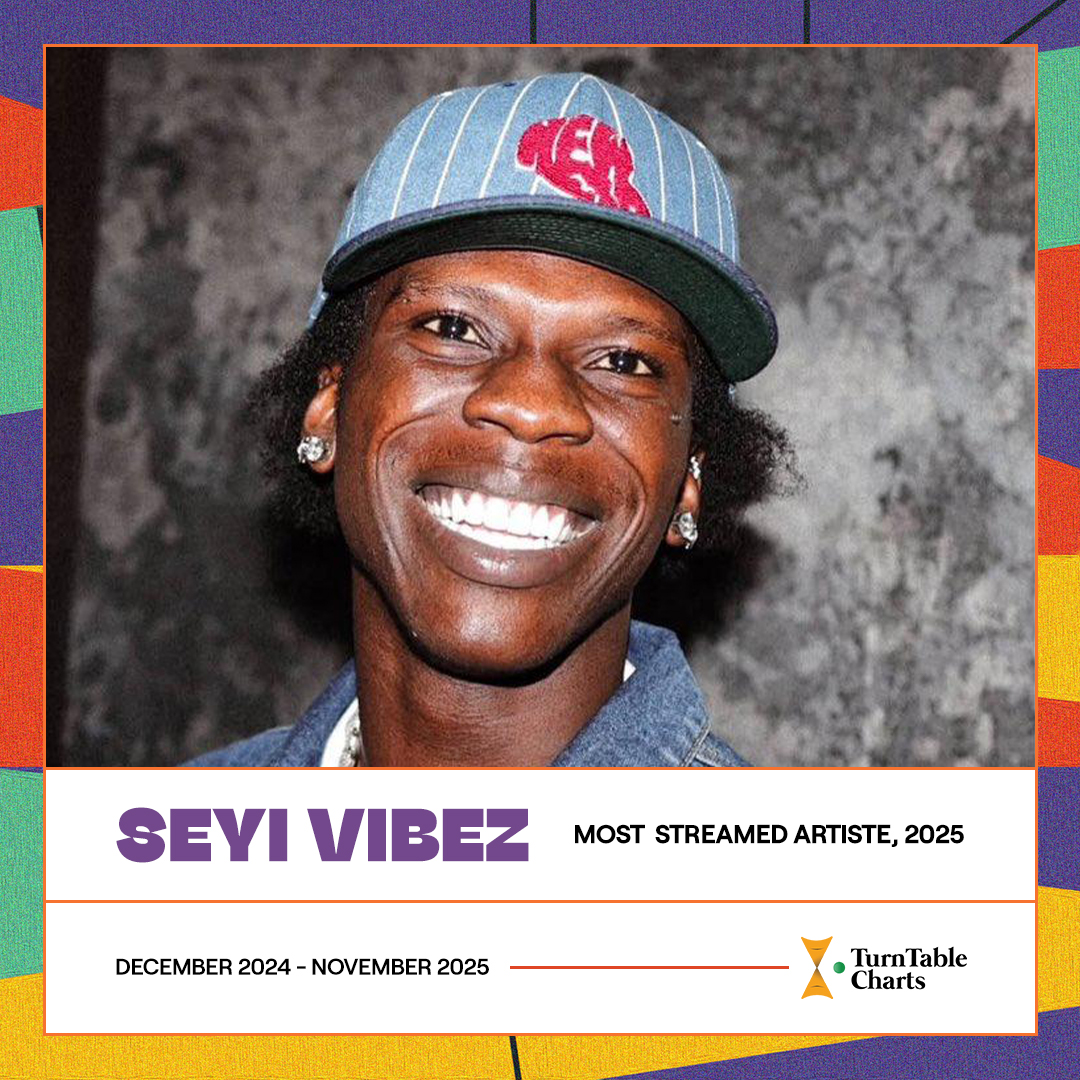
From that vantage point, his latest milestone feels less surprising than inevitable. After closing 2024 as Nigeria’s most-streamed artist, Seyi Vibez has retained the position in 2025. The achievement is striking because of how quietly it happened. His music remained unavoidable, familiar, and woven into daily life.
What makes this dominance remarkable is how little it relied on new output. In 2025, Seyi Vibez released Children of Africa, a four-track EP that arrived without spectacle. The project reaffirmed his long-standing identity as both street narrator and spiritual motivator, a voice fluent in ambition, pain, faith, and survival. Across his catalogue, success is not aspirational but assumed; struggle is not ornamental but foundational. These themes are not compartmentalised across projects but coexist, allowing listeners to return to him for different emotional needs at different times.
That emotional range is central to his endurance. Seyi Vibez does not make music for a single mood or demographic; he makes music that grows with the listener. This may explain why he is often an artist whom people initially resist. When Nigerians say Seyi Vibez’s music “isn’t for them,” history suggests it’s usually temporary. Time does the convincing. Old tweets resurface, opinions soften, and eventually the conversion happens. He is hardly an instant favourite, but he is frequently a long-term one. His catalogue rewards familiarity, not first impressions
His dominance also traces a clear cultural arc. Early on, Seyi Vibez’s appeal was distinctly class-based, rooted in the experiences and language of the streets he emerged from and the peers he grew up alongside. Over time, that base expanded. Younger listeners grew into his music. Older ones began to recognise themselves in it. Gradually, something more intangible took hold: a spiritual dimension, where his voice functioned not just as entertainment, but as reassurance. What began as representation evolved into resonance.
The year’s most persistent question follows naturally: how does an artist with a four-track EP, a single, and a handful of features finish as the most-streamed act of 2025?
Part of the answer exists outside his own releases. Earlier in the year, DJ YK Mule’s “Oblee,” featuring Seyi Vibez, became one of the country’s call to action for a good time. When “Oblee” comes on, the debate ends. Its chant “oblee, oblee, oblee” tells you to stop what you're doing and move to the music.
That ability to shape mood without requiring attention helps explain his streaming dominance. Seyi Vibez’s music has become habitual. Listeners are not chasing his next release; they are living inside what already exists. His catalogue behaves less like a series of moments and more like infrastructure, something you rely on rather than revisit.
This stands in contrast to the long-held industry fear that excessive output cannibalises attention. In 2017, DJBooth’s Yoh wrote about Future’s back-to-back releases (FUTURE and HNDRXX), describing them as an artist flooding his own market. At various points in his career, Seyi Vibez appeared to be courting a similar fate. Between 2021 and 2024 alone, he released 9 projects at a pace that felt unsustainable by conventional standards. Yet what looked like overexposure slowly revealed itself as endurance.
His 2025 slowdown, particularly after parting ways with Dapper Music, only clarified this dynamic. Fewer releases sharpened his visibility. The longest gap between projects gave listeners time to sit with the music rather than move past it. What once felt like relentlessness retroactively reads as generosity: an artist unwilling to hoard his work, unwilling to reduce music to files stored away on hard drives or in vaults, choosing instead to circulate it freely until it embedded itself into culture.
In 2025, several artists like Asake and Davido remained formidable contenders. Asake’s absence of a full-length project slowed his momentum, while Davido’s album cycle, though successful, lacked the quiet persistence that has come to define Seyi Vibez’s run. Consistency became the deciding factor.
If this period is written about five years from now, it will be remembered as the year Seyi Vibez’s music stood tall. What was once overlooked has embedded itself into everyday life.
What this year surprisingly revealed, even to those who already knew he was loved, is the scale of that attachment. With a four-track EP, a single, and a scattering of features, Seyi Vibez remains Nigeria’s most-streamed artist because his music has become a place people live in, one they keep returning to, long after the noise fades.