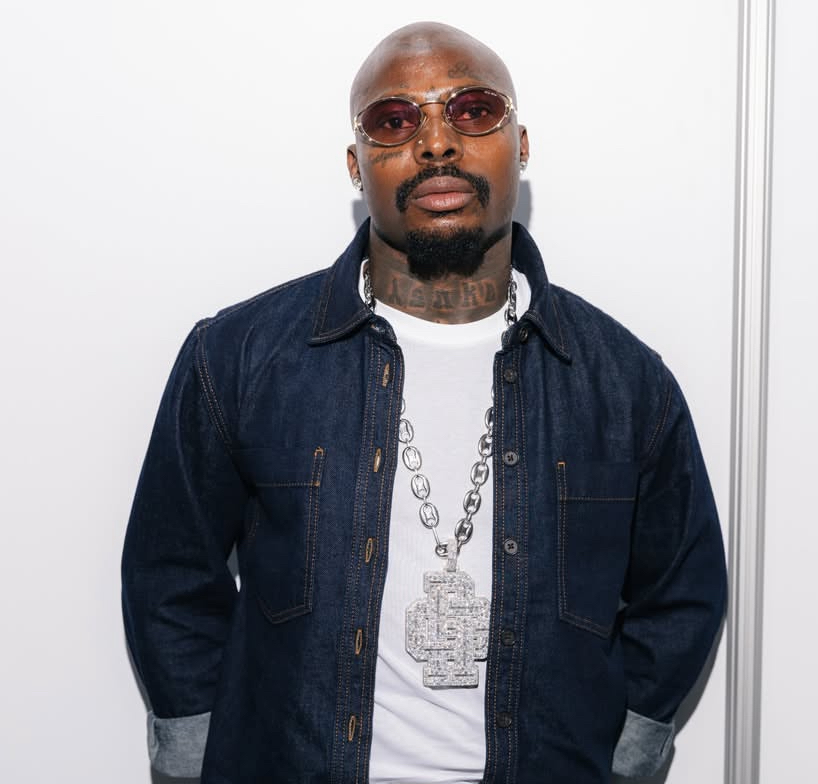
On sound, silence, and the discipline of sustained dominance
“I just blow, but I know my set.” — Peace Be Unto You (2022)
Asake’s rise is frequently described as explosive, but explosions imply disorder. His ascent has been governed by alignment. From his first mainstream releases, his sound, performance language, and release strategy moved in concert: chant-driven records designed for crowd participation, a visual identity that remained stable across cycles, and a refusal to oversaturate the market. By the end of 2022, after an EP, a debut album, three sold-out O2 Academy Brixton dates, and Flytime’s back-to-back shows, there was no escaping the man Ololade Asake. His work demonstrated a rare consistency between intention and execution.
That year, TurnTable Charts named him Artist of the Year. Three more would follow.
SOUND: FUJIPIANO AND THE REFUSAL OF NEUTRALITY
Asake’s sustained dominance begins with sound. Afrobeats, as a global label, often compresses regional traditions into a generalised pop form optimised for export. Asake resists this compression by centring Fuji, a genre historically rooted in Yoruba Muslim communities in Southwest Nigeria. Fuji is built on endurance rather than spectacle: layered percussion, elongated vocal phrasing, and communal call-and-response structures that prioritise participation over polish.
Fuji’s marginalisation in mainstream Nigerian pop has often reflected class bias, positioned as “street” or informal rather than sophisticated. Asake’s intervention has been to reject this hierarchy. Drawing from his Lagos Island upbringing, he emphasises Fuji’s celebratory function, foregrounding its role in social affirmation rather than treating it as raw material to be refined.
Across Mr. Money With The Vibe and Work of Art, Asake fused Fuji’s vocal cadence with Afro-pop melody and Amapiano’s restrained rhythmic architecture. The resulting hybrid, often described as neo-fuji or Fujipiano (Twitter made me do it), relied on repetition. Yoruba lyrics were not contextualised for foreign listeners; instead, rhythm carried meaning. This approach proved exportable precisely because it resisted neutrality. Audiences abroad learned the chants phonetically, reproducing them in live settings without mediation.
EVOLUTION: FROM URGENCY TO COMPOSURE
By the time Lungu Boy arrived in 2024, Asake had disrupted his own formula. The album pivoted away from Fuji and Amapiano-dominant structures toward a multi-genre palette that incorporated EDM, Hip Hop textures, melancholic passages, and collaborations with Stormzy, Central Cee, Ludmilla, Travis Scott, and Wizkid. Where earlier records featured Asake attacking beats with relentless energy, Lungu Boy slowed the tempo of his delivery, allowing space to replace urgency.
This move carried risk. The album’s breadth threatened to blur the sonic identity that had made Asake immediately recognisable. Global features introduced the possibility of displacement of the artist becoming an accessory to reach rather than its engine. For some listeners, the urgency of his earlier work felt muted.
Yet the restraint persisted. In 2025, singles like “Why Love” and “Badman Gangsta” extended the same composure, while his Red Bull Symphonic performance translated that control into orchestration. Whether this evolution represents long-term growth or strategic consolidation remains unresolved. What is clear is that Asake chose discipline over momentum, even at the cost of immediacy.
FAME WITHOUT EXPLANATION: THE YBNL EXIT
Asake’s departure from YBNL in early 2025 surprised many. The bond between Asake and Olamide had come to symbolise continuity between grassroots credibility and institutional support. YBNL’s position as one of Nigeria’s most consistent artist-development platforms made the exit structurally significant.
There was no press release, no public statement, no retrospective framing. Instead, Asake released “Military” independently, followed by “Why Love” under his own imprint, Giran Republic, distributed by EMPIRE, and later “Badman Gangsta” featuring Tiakola. The infrastructure changed; the voice did not.
Throughout 2025, Asake appeared selectively on projects by Sarz, J Hus, Olamide, and Young Jonn—while undergoing a visible but controlled aesthetic shift. Military silhouettes, change in hairstyle, muted palettes, and restrained stage presence replaced earlier exuberance. Fashion appearances, including Paris Fashion Week became a method of continuity rather than absence.
When the Redbull Symphonic show came, everything made sense. His outfit matched his aesthetics; the calm demeanour was now elegant. The audience wasn’t just Nigerians; it was global, in Asake ‘s words, “Mr Money Worldwide, e don goooooo”.
Asake transcended.
MEASUREMENT: WHAT FOUR TURNTABLE WINS ACTUALLY INDICATE
TurnTable Charts operates on a data-driven model, weighing streaming performance, radio rotation, and cultural impact, defined through sustained presence rather than peak virality. Its methodology favours consistency across time and platforms.
Within this framework, the four Artist of the Year wins reflect more than popularity. They indicate alignment between Asake’s output and the industry’s evolving metrics, prioritising longevity over novelty. Asake’s sustained performance suggests structural dominance.
LEGACY: THE NARROWING OF FAILURE
At this stage, failure has narrowed. For Asake, a competent album would register as underperformance, not because it would be weak, but because consistency has recalibrated expectations. This is the pressure of sustained excellence.
Asake altered scale, he has normalised chant-driven structures in mainstream Afrobeats, repositioned Yoruba-forward music as globally viable without translation, and demonstrated that silence can function as narrative control. These shifts are not easily reversible.
It has been over two million minutes since Asake released Ololade Asake, an EP that barely crossed the twelve-minute mark. For an artist once framed as a fleeting moment, the math has become difficult to ignore. If this was ever supposed to be fifteen minutes of fame, it has stretched into something far more durable, and it still appears to be accelerating.